Elektronik/Digital
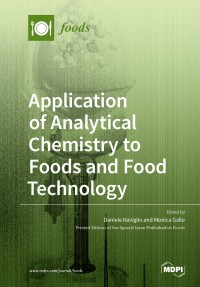
Application of Analytical Chemistry to Foods and Food Technology
Foods are a mixture of substances capable of supplying the human body with nutrients,
which, once metabolized, are used mainly for the production of energy, heat, replenishment,
and growth material for organs and tissues, ensuring the normal performance of vital functions
necessary for growth of the human body. Therefore, the study of the chemical composition of foods
and the properties of their constituents helps to define their nutritional and commodity values.
Furthermore, it allows for evaluation of the chemical modifications that the constituents of the food
undergo following the treatments (Food Technology) to which they are subjected. Analytical chemistry
is the branch of chemistry based on the qualitative and quantitative determination of compounds
present in a sample under examination. Therefore, through its application, it is possible to determine
the quality of a product and/or its nutritional value, reveal adulterations, identify the presence of
xenobiotic substances potentially harmful to human health (heavy metals, IPA, pharmaceuticals, etc.).
Furthermore, some foods, in particular those of plant origin, contain numerous substances, secondary
metabolites, with huge beneficial effects for human health. These functional components can be
taken both through a correct diet, but also obtained from different food matrices by technological or
biotechnological processes for the formulation of both functional foods and/or nutraceutical products.
This Special Issue brings together 10 original studies and two comprehensive reviews on the above
topics, in particular: (i) processes of extraction, identification, and characterization of biologically
active compounds from different food matrices, (ii) overview of the main techniques applied for the
determination of food colors, (iii) newer and greener solid-liquid extraction techniques.
Ketersediaan
Informasi Detail
- Judul Seri
-
-
- No. Panggil
-
-
- Penerbit
- Basel : MDPI., 2020
- Deskripsi Fisik
-
226 hlm.
- Bahasa
-
Inggris
- ISBN/ISSN
-
978-3-03943-461-9
- Klasifikasi
-
NONE
- Tipe Isi
-
-
- Tipe Media
-
-
- Tipe Pembawa
-
-
- Edisi
-
-
- Subjek
- Info Detail Spesifik
-
-
- Pernyataan Tanggungjawab
-
-
Versi lain/terkait
Tidak tersedia versi lain
Lampiran Berkas
Komentar
Anda harus masuk sebelum memberikan komentar
 Karya Umum
  Filsafat
  Agama
Agama  Ilmu-ilmu Sosial
  Bahasa
  Ilmu-ilmu Murni
  Ilmu-ilmu Terapan
  Kesenian, Hiburan, dan Olahraga
  Kesusastraan
  Geografi dan Sejarah