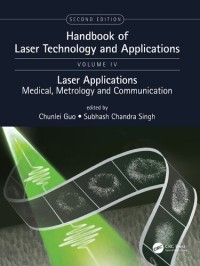
Computer File
Handbook of Laser Technology and Applications, Volume 4: Laser Applications: Medical, Metrology and Communication
This updated Handbook comes at the time when the world just
celebrated the 60th anniversary of the laser. Compared to most
felds in science and technology, the laser is still a relatively
young one, but its developments have been astonishing. Today,
hardly any area of modern life is left untouched by lasers, so
it is almost impossible to provide a complete account of this
subject.
As challenging as it is, this updated Handbook attempts to
provide a comprehensive coverage on modern laser technology
and applications, including recent advancements and state-of-
the-art research and developments. The main goal of develop-
ing this Handbook is to provide both an overview and details
of ever-expanding technologies and applications in lasers.
We want this Handbook to be useful for both newcomers
and experts in lasers. To meet these goals, the chapters in this
Handbook are typically developed in a style that does not
require advanced mathematical tools. On the other hand, they
are written by the experts in each area so that the most impor-
tant concepts and developments are covered.
The frst edition of the Handbook was released in 2003. It
has been hugely popular and ranked as one of the top ten most
referenced materials by the publisher. Eighteen years later,
although a relatively short period for many more established
scientifc felds, the Handbook has become outdated, and an
update is overdue. The rapid changes in lasers are certainly
reinforced by my own experience of teaching and researching
the subject in the Institute of Optics at University of Rochester.
Flipping through my old lecture notes on lasers, I am often
amazed at how much progress we have witnessed in this feld
over the years.
I am indebted to the editors of the frst edition, Colin Webb
and Julian Jones, who brought this original Handbook into
existence. When I was asked to take over this second edi-
tion, it laid before me a daunting task of how to rejuvenate the
Handbook while keeping its original favour. Since many of
the fundamental principles of the laser are well established,
we tried to honour the original authors by keeping the chap-
ters on fundamental concepts where possible. If a revision is
needed, we usually started by asking the original authors for
the revision but if impossible, we brought in new authors to
revise these chapters.
As the laser shines in modern applications, we added a large
number of new chapters refecting the most recent advance-
ments in laser technologies. Throughout the Handbook,
entirely new sections were added, including sections on mate-
rials processing, laser spectroscopy and lasers in imaging and
communications. Nearly all chapters in these sections are
either entirely new or substantially revised. On the other hand,
some of the topics previously included have seen dwindling
relevance today. We had to make the hard decision to let go of
some of these outdated chapters from the frst edition. Despite
these deletions, this new Handbook still grows signifcantly
from the original three volumes to the current four volumes.
Bringing this large project to its conclusion is the collec-
tive efforts of many individuals. It began with the encourage-
ment and guidance of Lu Han, the then managing editor of
this Handbook. I know how much Lu cared about this proj-
ect. I still remember an initial phone call with Lu, we fnished
it at a late afternoon past 5 pm. Over the phone, I was told
that I would receive the frst edition of this Handbook. To my
surprise, I had the handbooks in my hand the next morning.
At CRC press, this project was later passed onto Carolina
Antunes and fnally to Lara Spieker, who has been essential in
bringing this project to its conclusion.
Many people have provided me with indispensable help. My
co-editor, Subhash C. Singh, at the University of Rochester,
helped chart the layout of this new edition and worked along
with me throughout this project. Ying Zhang, who was a senior
editor at Changchun Institute of Optics, Fine Mechanics,
and Physics (CIOMP) in China, spent a half year with us in
Rochester, where his years of professional editorial experi-
ence helped move this project forward signifcantly. Lastly, my
thanks go to Pavel Redkin of CIOMP, who made signifcant
contributions in communicating with the chapter authors and
guiding them throughout the project. Additionally, my appre-
ciation goes to Kai Davies, Sandeep K. Maurya, Xin Wei, and
Wenting Sun for their help in this Handbook project.
Ketersediaan
Informasi Detail
- Judul Seri
-
-
- No. Panggil
-
-
- Penerbit
- Boca Raton : CRC Press., 2021
- Deskripsi Fisik
-
495p
- Bahasa
-
Inggris
- ISBN/ISSN
-
9781003130123
- Klasifikasi
-
NONE
- Tipe Isi
-
-
- Tipe Media
-
-
- Tipe Pembawa
-
-
- Edisi
-
-
- Subjek
-
-
- Info Detail Spesifik
-
-
- Pernyataan Tanggungjawab
-
-
Versi lain/terkait
Tidak tersedia versi lain
Lampiran Berkas
Komentar
Anda harus masuk sebelum memberikan komentar
 Karya Umum
  Filsafat
  Agama
Agama  Ilmu-ilmu Sosial
  Bahasa
  Ilmu-ilmu Murni
  Ilmu-ilmu Terapan
  Kesenian, Hiburan, dan Olahraga
  Kesusastraan
  Geografi dan Sejarah