Ditapis dengan

Ihya Ulumiddin : Menghidupkan Kembali Ilmu-Ilmu Agama : 6 Dunia dan Godaannya
“Jika semua kitab Islam hilang, dan yang tersisa hanya Ihya ‘Ulumiddin, ia dapat mencukupi semua kitab yang hilang tersebut” —–Imam Nawawi, Ulama dan penulis kitab Riyad Al-Shalihin Boleh jadi jalan yang kita lalui sekarang ini jauh dari tujuan. Ibarat panggang jauh dari api. Maksud hati merengkuh kebahagiaan, justru kepedihan dan kesusahan yang diraih. Hal ini sangat mungkin…
- Edisi
- -
- ISBN/ISSN
- -
- Deskripsi Fisik
- vi, 400p
- Judul Seri
- -
- No. Panggil
- -

Ihya Ulumiddinn : Menghidupkan Kembali Ilmu-Ilmu Agama : 7 Pintu Taubat
“Jika semua kitab Islam hilang, dan yang tersisa hanya Ihya ‘Ulumiddin, ia dapat mencukupi semua kitab yang hilang tersebut” —–Imam Nawawi, Ulama dan penulis kitab Riyad Al-Shalihin Boleh jadi jalan yang kita lalui sekarang ini jauh dari tujuan. Ibarat panggang jauh dari api. Maksud hati merengkuh kebahagiaan, justru kepedihan dan kesusahan yang diraih. Hal ini sangat mungkin…
- Edisi
- -
- ISBN/ISSN
- 978-602-8997-13-3
- Deskripsi Fisik
- vi, 415p
- Judul Seri
- -
- No. Panggil
- -

Ihya Ulumiddin : Menghidupkan Kembali Ilmu-Ilmu Agama : 8 Sabar dan Syukur
“Jika semua kitab Islam hilang, dan yang tersisa hanya Ihya ‘Ulumiddin, ia dapat mencukupi semua kitab yang hilang tersebut” —–Imam Nawawi, Ulama dan penulis kitab Riyad Al-Shalihin Boleh jadi jalan yang kita lalui sekarang ini jauh dari tujuan. Ibarat panggang jauh dari api. Maksud hati merengkuh kebahagiaan, justru kepedihan dan kesusahan yang diraih. Hal ini sangat mungkin…
- Edisi
- -
- ISBN/ISSN
- 978-602-8997-14-0
- Deskripsi Fisik
- vi, 387p
- Judul Seri
- -
- No. Panggil
- -

Ihya Ulumiddinn = Menghidupkan Kembali Ilmu-Ilmu Agama : 9 Zuhud, Cinta dan K…
“Jika semua kitab Islam hilang, dan yang tersisa hanya Ihya ‘Ulumiddin, ia dapat mencukupi semua kitab yang hilang tersebut” —–Imam Nawawi, Ulama dan penulis kitab Riyad Al-Shalihin Boleh jadi jalan yang kita lalui sekarang ini jauh dari tujuan. Ibarat panggang jauh dari api. Maksud hati merengkuh kebahagiaan, justru kepedihan dan kesusahan yang diraih. Hal ini sangat mungkin…
- Edisi
- -
- ISBN/ISSN
- 978-602-8997-15-7
- Deskripsi Fisik
- viii, 500p
- Judul Seri
- -
- No. Panggil
- -

Islam and Rationality : The Impact of al-Ghazālī Papers Collected on His 90…
This volume offers an account of Abu Hamid al-Ghazali (d. 505/1111) as a rational theologian who created a symbiosis of philosophy and theology and infused rationality into Sufism. The majority of the papers herein deal with important topics of al-Ghazali's work, which demonstrate his rational treatment of the Qur'an and major subjects of Islamic theology and everyday life of Muslims. Some othe…
- Edisi
- -
- ISBN/ISSN
- 978-90-04-29095-2
- Deskripsi Fisik
- xxiii, 454p
- Judul Seri
- -
- No. Panggil
- -

Ethical Teachings of Abu Ḥamid al-Ghazali: Economics of Happiness
This book studies the interplay of economic philosophy and moral conduct as reflected in the writings of one of the most renowned scholars in Islamic history, Abū Ḥāmid Muḥammad ibn Muḥammad al-Ghazālī (d. 1111). As is well known, Imām al-Ghazālī, nicknamed “the proof of Islam”, contributed immensely to Islamic theology, philosophy, and Sufism or Islamic mysticism (taṣawwuf).…
- Edisi
- -
- ISBN/ISSN
- 978-1785275302
- Deskripsi Fisik
- xii, 162p
- Judul Seri
- Anthem Religion and Society Series
- No. Panggil
- -
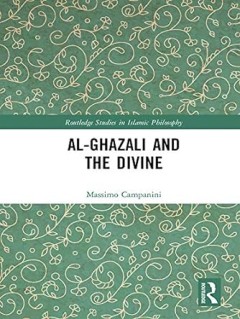
Al-Ghazali and the Divine
This book examines the philosophy of al-Ghazali, analysing his conception of God within Islamic theology. Seeking to contribute to the greater understanding of Muslim thought, it analyses his ‘orthodox’ theory, based on the notion that the spiritual struggle (jihad) and philosophical enquiry are informed by the possession of firm science (‘ilm). Exploring a wide range of Arab texts and…
- Edisi
- -
- ISBN/ISSN
- 978-0367586102
- Deskripsi Fisik
- vii, 154p
- Judul Seri
- Routledge Studies in Islamic Philosophy
- No. Panggil
- -

Politics of the Islamic Tradition : The thought of Muhammad al-Ghazali
Over the last two centuries the Muslim world has undergone dramatic transformations, impacting the Islamic tradition and throwing into question our understanding of tradition. The notion of tradition as an unmoving edifice is contradicted by the very process of its transmission, and the complex role human beings play in creating and sustaining traditions is evident in the indigenous mechanisms …
- Edisi
- -
- ISBN/ISSN
- 978-1138614673
- Deskripsi Fisik
- xi, 185p
- Judul Seri
- Routledge Studies in Middle Eastern Democratization and Government
- No. Panggil
- -

Ahmad al-Ghazālī, Remembrance, and the Metaphysics of Love
The teachings of Aḥmad al-Ghazālī changed the course of Persian Sufism forever, paving the way for luminaries such as Rūmī, Aṭṭār, and Ḥāfiẓ. Yet he remains a poorly understood thinker, with many treatises incorrectly attributed to him and conflicting accounts in the historiographical literature. This work provides the first examination of Aḥmad al-Ghazālī and his work in We…
- Edisi
- -
- ISBN/ISSN
- 9781438459660
- Deskripsi Fisik
- x, 259p
- Judul Seri
- SUNY series in Islam
- No. Panggil
- -

Al-Ghazali, Averroes and the Interpretation of the Qur'an: Common Sense and P…
This book examines the contrasting interpretations of Islam and the Qur’an by Averroes and Al-Ghazali, as a way of helping us untangle current impasses affecting each Abrahamic faith. This has traditionally been portrayed as a battle between philosophy and theology, but the book shows that Averroes was rather more religious and Al-Ghazali more philosophical than they are usually portrayed. …
- Edisi
- -
- ISBN/ISSN
- 978–0–203–86511–8
- Deskripsi Fisik
- xiii, 130p
- Judul Seri
- -
- No. Panggil
- -
 Karya Umum
  Filsafat
  Agama
Agama  Ilmu-ilmu Sosial
  Bahasa
  Ilmu-ilmu Murni
  Ilmu-ilmu Terapan
  Kesenian, Hiburan, dan Olahraga
  Kesusastraan
  Geografi dan Sejarah